Just What Is Plaque?

September 13th, 2023

From the time you were small, you’ve been warned about the dangers of plaque. Why? Because:

  • It’s an unpleasant film that sticks to your teeth
  • It causes cavities
  • It causes gum disease
  • It can cause extra problems when you wear braces

And really, do we need to know much more than this to motivate us to brush? But if you’re in a curious mood, you might be wondering just how this soft, fuzzy film accomplishes all that damage. Let’s take a closer look at the sticky problem of plaque.

How does plaque form?

We live with hundreds of species of oral bacteria, most of which are harmless, and some of which are actually beneficial. But when our oral ecosystem gets out of balance, problems can occur. For example, without regular and thorough brushing and flossing, we start to build up plaque.

Plaque starts forming within hours of your last brushing. And even though plaque fits the very definition of “seems to appear overnight,” this biofilm is actually a complex microbial community with several different stages of development.

  • It starts with saliva.

Saliva is vital to our oral health, because it keeps us hydrated, washes away food particles, neutralizes acids in the mouth, and provides minerals which keep our enamel strong. Saliva also contains proteins, which help form a healthy, protective film on the tooth surface. This film is called a pellicle.

  • Bacteria attach to the pellicle.

There are species of oral bacteria that are able to attach themselves to the pellicle film within hours of its formation. As they become more firmly attached, they begin to grow and divide to form colonies, and are known as the early colonizers of the plaque biofilm.

  • A complex biofilm forms.

If you’ve skipped brushing for a few days (please don’t!), you’ll notice a fuzzy, sometimes discolored film on your enamel—that’s a thriving plaque community, and it only takes a matter of days to go from invisible to unpleasant.

If you’re not removing plaque regularly, it can harden further and become tartar. And once you have tartar buildup, you’ll need the care of a dental professional to remove it.

  • What happens if we ignore plaque and tartar?

We get cavities and gum disease.

How does plaque cause cavities?

  • The bacteria in plaque, like all organisms, need nutrients.

Our normal oral environment and the food in our everyday diets provide the nutrients plaque needs. And, as we mentioned above, certain types of oral bacteria convert these nutrients into acids. Foods such as carbohydrates, starches, and sugars are most easily converted into acids, which is why we recommend that you enjoy them in moderation.

  • The biofilm promotes acid production.

Within the plaque film, anaerobic bacteria (bacteria which don’t use oxygen) convert sugars and starches into acids. As the plaque film becomes denser, it blocks acid-neutralizing saliva and oxygen from reaching these bacteria close to the tooth’s surface, creating an ideal environment for the bacteria to produce their acid waste products.

  • Acids attack enamel.

The sticky nature of plaque keeps these acids in contact with tooth enamel, where, over time, acids dissolve minerals in enamel, weakening the mineral structure of the tooth.

How does plaque cause gum disease?

  • Bacteria cause inflammation and gingivitis.

The bacteria in plaque irritate the delicate tissue of the gums, which causes an inflammation response which can leave your gums swollen, red, bleeding, or tender. This early form of gum disease is gingivitis. Fortunately, good dental care and careful brushing and flossing can usually prevent and even eliminate gingivitis.

  • Plaque and tartar can lead to periodontitis.

When plaque and tartar build up around and below the gumline, the gums pull away from the teeth, leaving pockets where bacteria collect, leading to infection as well as inflammation. Infections and constant inflammation not only harm gum tissue, they can destroy the bone supporting the teeth. This serious gum condition is periodontitis, and should be treated immediately to avoid further infection and even tooth loss.

How does plaque affect orthodontic patients?

  • Plaque collects around your braces.

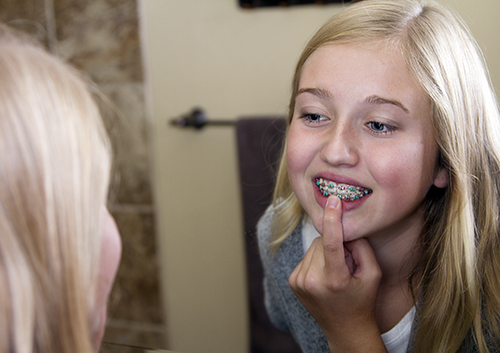
Braces provide plenty of spots for plaque to hide from your brush. If you aren’t extremely diligent with your brushing and flossing, plaque collects near brackets, wires, and bands—all those spots that a brush and floss find difficult to reach.

  • Plaque promotes demineralization

The demineralization process we mentioned above can cause white spots on teeth (decalcification), where minerals have dissolved. Sometimes these spots can be treated, and sometimes they are permanent. They can become quite sensitive, and may lead to cavities.

Careful brushing and flossing around your braces will help eliminate the plaque that can cause demineralization near brackets. Ask Dr. Lowder about the tools and the brushing and flossing techniques which will give you the best results.

How do we fight plaque?

From the time you were small, you’ve learned how to fight plaque:

  • Brush at least twice a day for two minutes, and be sure to brush all of your tooth surfaces and around the gumline.
  • Floss to remove plaque from between the teeth and near the gumline.
  • See your dentist as recommended for a thorough professional cleaning.

Be proactive. If you have any questions, talk to us at our Idaho Falls, Rigby, Rexburg, Afton, and Salmon office about the best way to keep plaque at bay. We can show you the most effective ways to brush and floss, recommend anti-plaque toothpastes and rinses, even suggest plaque-revealing tablets if you’re missing some trouble spots.

We’ve only brushed up on some plaque basics, because there is a lot more to discover about this complex biofilm. Happily, even with all there is to learn about plaque’s growth and development, it’s reassuring to know that getting rid of it is quite simple—with just a soft-bristled brush, some dental floss, and a few minutes of your time each day, you’re on the way to a healthy, happy, plaque-free smile.

Snacks for Healthy Teeth while Watching the Big Game

September 13th, 2023

It's almost game day and you're wondering what to put on the menu for your guests. Most snacks are typically highly processed and unhealthy. Why not mix it up this year and opt for some snacks that promote good oral health? Here are some of Dr. Lowder favorites!

  • Apples, carrots, celery, and cucumbers: These foods and other crispy, fibrous, fruits and vegetables are an excellent choice for the big game. Not only are they rich in vitamins and minerals which your body and mouth need, they are also known as detergent foods because of the cleaning effect they have on the teeth and gums. Try apples wedges spread with peanut butter and sprinkled with cinnamon.
  • Beans: Beans are filling because they are packed with fiber and that keeps you from opting for sugary or fatty snacks. Along with fruits and vegetables, beans should be one of the stars of your game-day snack lineup. How about some hearty chickpea hummus with cucumber chips?
  • Nuts like almonds, walnuts, pistachios, and cashews: Nuts abound in the minerals that help keep your teeth and gums strong like calcium, magnesium, and potassium. Put out a bowl of raw or roasted nuts for your guests as a crunchy, satisfying alternative to chips or crackers. Recent research even shows that the polyunsaturated fatty acids in nuts may help prevent gum disease. But remember not to eat the whole bowl! Nuts are very high in calories and a little goes a long way. Enjoy and handful or two along with your other healthy snacks.
  • Dark chocolate: This one may be hard to believe at first, but research shows chocolate can be great for your teeth and help prevent decay! Now don't run off and start stocking your pantry with a bunch of that super sweet stuff, because these benefits come mainly from the tannins, polyphenols, and flavonoids present in the cacao bean. Dark chocolate is the least processed variety of chocolate and the closest to the cacao bean, so make sure you purchase a variety that is listed as 70% cocoa or more for these benefits. Like with nuts, chocolate is easy to overdo — aim to eat two or three squares.

Water Flossers and Braces

September 6th, 2023

You devote a lot of energy to your orthodontic treatment. Appointments, rubber bands, adjustments, cleaning (so much cleaning)—and why? Because you know that your attractive, healthy smile will be well worth the effort.

But if you find that keeping your teeth and braces clean requires more time and energy than it should, and you’re still not getting the results you’d like, a water flosser might be just the tool you need to help make your cleaning routine easier and more effective.

Plaque and tartar can be a real problem when you wear braces. Cleaning around braces and wires can be a challenge, and it can be difficult to get floss between your teeth and close to your gums, even with special threaders or floss designed to slip behind your wires.

But ignoring bacteria and plaque build-up can lead to cavities, weakened or discolored enamel, and gum problems. Fortunately, a water flosser can help wash away food particles, bacteria, and plaque even in tight, hard-to-reach spaces, while providing gentle cleaning along sensitive gums.

Water flossers use a pulsing stream of water to remove food particles and plaque between and around teeth. You can adjust the water pressure to apply just the right amount of cleaning power, and then direct the flow to your gum line, between your teeth, around your brackets, or anywhere else you need. Some models even offer tapered heads with brushes designed specifically for cleaning braces.

You might consider investing in a water flosser if you have:

  • Mobility issues. If you have joint or mobility issues, a water flosser will let you clean those hard-to-reach areas more easily.
  • Lingual braces. Because lingual braces are on the inside of the teeth, they can be more difficult to clean effectively with regular brushing and flossing.
  • Problems removing plaque. If you find that you are brushing and flossing regularly, but still have plaque build-up around your braces, give water flossing a try.

A beautiful smile is well worth all the time and effort you are devoting to it. If you think a water flosser might save you a bit of that time and effort, and provide better cleaning power, talk to Dr. Lowder  about your options during your next visit to our Idaho Falls, Rigby, Rexburg, Afton, and Salmon office. We’ll let you know if traditional flossing, a water flosser, or a combination of the two will give you your cleanest, healthiest smile.

Famous Teeth throughout History

September 6th, 2023

We probably all remember sitting through history lessons during our schooling years. Revolutionary war heroes, English royals, and pop-culture icons filled the pages of our textbooks. Although you may recall a detail or two about their historical significance, how much do you know about their teeth?

Picture England in the mid 1500s. People wore frilly clothes as they hustled along the street, and talked about the latest import from the Indies: sugar. Wealthy Brits did not hesitate to indulge their sweet tooth, and it was no different for the monarch, Queen Elizabeth I.

The queen was especially fond of sweets, but not so fond of the dentist. Her teeth rotted; they turned black and gave off a foul odor. Eventually, Elizabeth lost so many teeth that people found it difficult to understand her when she spoke.

Flash forward to the Revolutionary-era colonies in the 1770s and we encounter the famous dentures of George Washington. They were not made of wood, but rather a combination of ivory and human teeth, some of which were his own pulled teeth and some he purchased from slaves.

Washington did not practice proper dental hygiene throughout his life. He began to suffer dental problems as early as age 24, when he had his first tooth pulled. By the time he was inaugurated in as the first president in 1789, he had only one tooth remaining in his mouth, which was pulled in 1796.

Washington’s dentures were made too wide and never quite fit his mouth properly. He complained that they were painful to wear and caused his jaw to protrude visibly outward.

If you’ve heard of Doc Holliday, you know him as the gun-toting, mustached criminal that ran the Wild West in the late 1800s. You might be surprised to learn that John Henry “Doc” Holliday actually had a career as a dentist.

He graduated from dental school in 1872 and began to practice in Griffin, Georgia. Holliday was later diagnosed with tuberculosis and his violent coughing fits during exams drove patients away. Jobless, he packed his bags for Texas and spent the rest of his days running from town to town as a criminal.

The Beatles brought pop music and British culture to their fans, as well as … teeth? In the mid-1960s, John Lennon had a molar removed that he presented as a gift to his housekeeper, Dorothy. Dorothy’s daughter was a huge fan of the Beatles and he thought she might like to a keepsake. Her family held onto the tooth until 2011, when they auctioned it off to a Canadian dentist for $31,000.

These historical figures had very different experiences with their teeth, but it’s safe to say a bit of extra brushing and flossing could’ve saved them a lot of trouble. Whether you’re queen, president, or an average citizen, it’s up to you to practice good dental hygiene!

Ask a member of our team at our Idaho Falls, Rigby, Rexburg, Afton, and Salmon office if you have any questions about how to keep your teeth in top shape!

“Dr. Lowder and his staff are professional, honest, trustworthy, hard working, friendly, dedicated, and genuinely care about the well being of their patients. My teeth and bite have never looked better in my life and I am indebted to Lowder Orthodontics for the incredible service they have given me.”

~ M. Jiménez

“Before I decided this was the office for my orthodontic work, I had three consultations. I have never been at ease when it comes to work on my teeth. I know I chose the right orthodontist and staff for me. Thank you so much for everything these past couple years. You all have been amazing!”

~ Jeannie A.

“Getting braces was not something I looked forward to doing. I’m so glad I came to Lowder Orthodontics! The entire staff made me feel good every visit. Best experience that I could have while fixing my teeth!! Thanks for the fun times!”

~ Brennan R.
Back to Top
Pixel